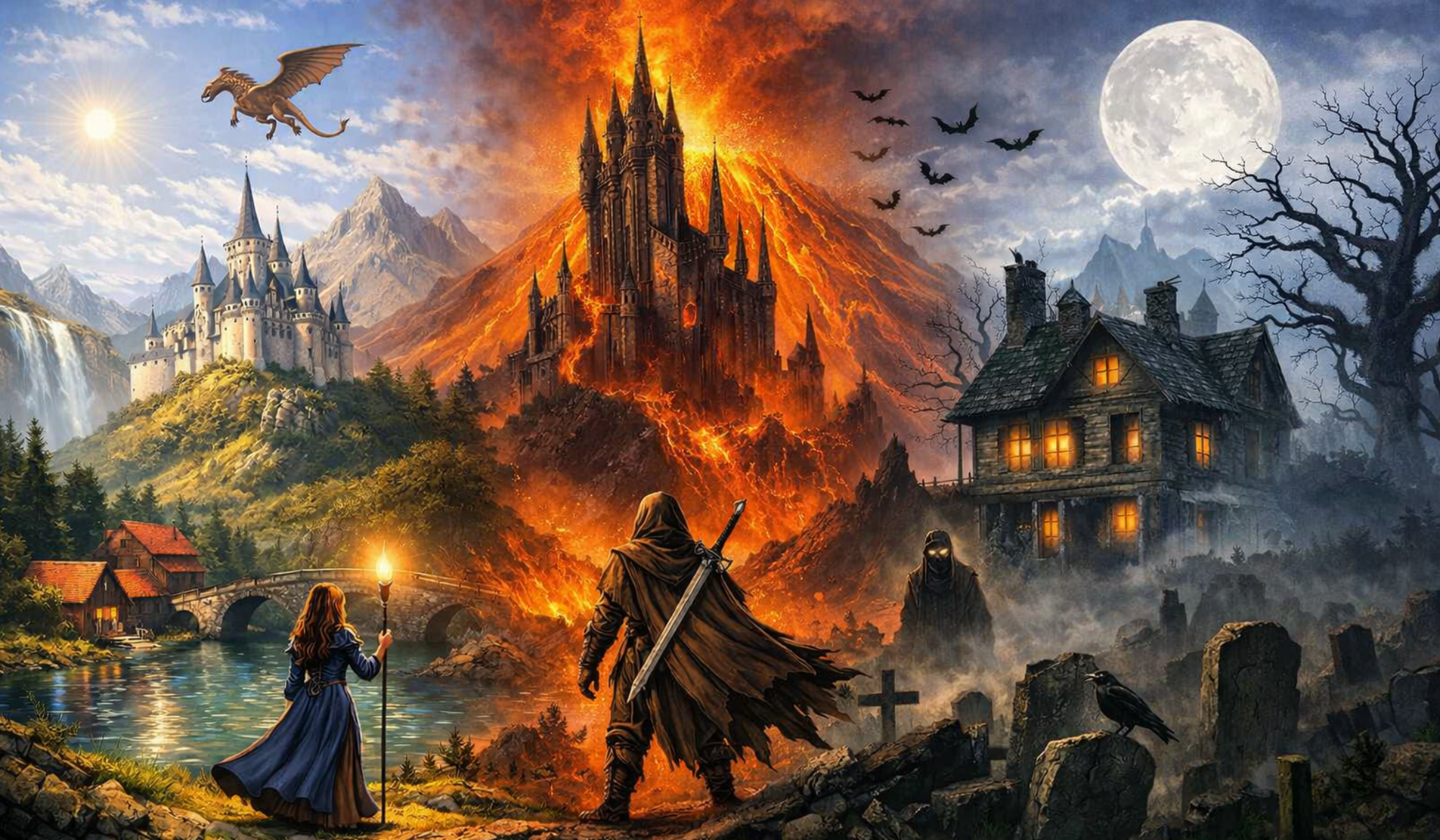
CREATURES OF THE NORTHERN HEMISPHERE

Hello Readers,

Welcome to the next post from my creature files. You may recall the Rib-back, a Canadian terror from a previous post. Well while I was searching for this beast I came across another frightful being. It’s the kind of thing the locals whispered about around campfires when the wind cut through the pines. Known as the Shadow-tail Cabin Creeper, this is no ordinary Raccoon. You’ll be hard pressed to find a more vicious creature of its size. And a scary thing about them is, where you find one, there are usually a few more in tow.

SHADOW‑TAIL CABIN CREEPER

A vicious looking raccoon bares its teeth, its eyes glowing red, and the skeletal remains of a person lay at its clawed paws.

Procyon umbracaudus tenebris“Shadow-Tail Cabin Creeper”

(Also Known As “The Pine‑Hollow Butcher”)

Origin

Born from generations of raccoons forced to scavenge in cursed logging grounds, the species adapted to the dark resonance of abandoned cabins and blood-soaked soil. Over time, their bodies twisted to match the predatory hunger that seeped into the land. Locals claim the first Creeper emerged after a winter famine drove a raccoon pack to cannibalism beneath a moonless sky.

Physiology

  • Matted charcoal fur that absorbs light
  • Elongated muzzle with serrated, needle‑like teeth
  • Eyes glowing red from hyper‑vascularised night vision
  • Hooked claws capable of rending bark, bone, and flesh
  • Prehensile “shadow-tail” used for balance, strangling, or anchoring during ambush
  • Musculature far denser than a normal raccoon, granting unnatural strength
  • Carrion‑tainted saliva that accelerates decay in prey

Behaviour

  • Hunts in loose packs of three to six, though scouts often appear alone
  • Displays eerie stillness before striking, as if listening to something beneath the soil
  • Known to toy with prey, dragging bodies into dens to rot
  • Highly territorial around abandoned cabins, root cellars, and logging shacks
  • Communicates through low, rattling chittering that echoes unnaturally far in the pines

Habitat

Dense pine forests, derelict cabins, forgotten hunting trails, and regions where human habitation has decayed into silence.

Abilities

  • Shadow Pounce: Launches from darkness with near‑silent acceleration
  • Rot‑Claw Rend: Claws coated in necrotic saliva cause rapid tissue breakdown
  • Pack Convergence: Nearby Creepers are drawn to the kill-site within minutes
  • Fear Scent: Releases a musk that induces panic in small animals and unease in humans
  • Corpse Burrow: Hides within carcasses or debris piles to ambush intruders

Weaknesses

  • Bright, sustained light disorients them.
  • Fire drives them back.
  • Their heightened senses make them vulnerable to high‑pitched metallic sounds.
  • Lone Creepers are far less bold without pack support.

Cultural Lore

Campfire tales warn that if you see one Creeper watching from the treeline, two more are already circling behind you. Old trappers insist the faint cabin window glow seen deep in the woods isn’t a lantern — it’s the reflection of their eyes, waiting for you to step closer.

Would you survive if a group of these creatures visited your cabin at night? You better not leave any food scraps in your garbage can, just to be on the safe side.

If you’re interested in seeing more of my creature posts, you can find them in my Bestiary.

Happy Reading!

THE SERPENT‑ASCENDED: DRAGONS OF THE AUSTRALIAN REALMS

Hello Readers,

Welcome back to my Australian dragon series. This week’s post brings you the…

INLAND TAIPAN DREAD WYRM

A large ash-grey dragon, spewing its yellowish toxin breath over the outback desert's rocky surface.

Draco microlepidotus mortis — “The Pale Doom”

Origin

The Fierce Snake’s venomous potency drove an evolutionary path toward a mythic apex predator.

Physiology

  • Bone‑white or ash‑grey scales
  • Heavy, plated skull with multiple horns
  • Venom sacs evolved into pressurised toxin jets
  • Wings with cracked‑earth patterning

Behaviour

  • Solitary, contemplative, almost ritualistic
  • Burrows deep beneath desert stone
  • Emerges only during heatwaves or omens

Habitat

Deep desert, badlands, scorched mesas

Abilities

  • Toxin Jet Breath: Melts armour and stone
  • Burrow Surge: Erupts from beneath prey
  • Solar Overcharge: Absorbs heat to amplify power

Weaknesses

Cold renders it sluggish; nocturnal activity limited

Cultural Lore Said to be born from the first lightning strike that ever hit the desert.

The below image illustrates the Draco microlepidotus mortis performing a solar overcharge:

A fiery dragon; the wyrm’s scales glow like molten glass, its wings crackle with lightning fissures, and its breath becomes a torrent of solar fire that turns the desert into rivers of lava.

If you’re interested in seeing more of my creature posts, you can find them in my Bestiary.

Happy Reading!

CREATURES OF THE AUSTRALIAN REALMS

Hello Readers,

Here is another post from my creature files. This terrifying animal was once extinct, but scientists meddling with the cloning of genes tried to bring it back to life and re-introduce it to the world. They partially succeeded, though you can’t really say this Thylacine is alive. Meet the Bone-Striped Tiger, an undead devil sometimes referred to as a Rot Runner by the locals.

BONE‑STRIPED TIGER

A zombie like Tasmanian Tiger stands before a lake with mountains in the background. Its eyes glow red and rotten flesh oozes from its open ribcage.

Thylacinus ossifera revenant“The Rot Runner”

Origin In an ill‑fated attempt to resurrect the extinct Thylacine, geneticists spliced preserved Tasmanian tiger DNA with experimental regenerative sequences designed to repair cellular collapse. The process reanimated the body but failed to restore true life. What emerged was neither clone nor animal, but an undead predator driven by instinct, hunger, and a strange, lingering echo of its former species.

Physiology

Emaciated, wolf‑like frame with exposed ribs and necrotic musculature

Bone‑pale striping along the flanks, glowing faintly in low light

Elongated jaws with desiccated lips pulled back from permanent snarl

Eyes burning with unnatural red luminescence

Limbs reinforced by partial ossification, granting unnatural speed

Thickened tail vertebrae forming a whip‑like, skeletal lash

Behaviour

Hunts in erratic bursts, alternating between stillness and explosive pursuit

Drawn to heat, movement, and the scent of decay

Displays territorial pacing patterns reminiscent of living thylacines

Emits a rasping, breathless bark‑snarl that carries across wetlands

Shows uncanny persistence, tracking prey long after a normal predator would give up

Habitat

Swamp margins, dead forests, abandoned research sites, mist‑choked valleys, and any region where rot, stagnant water, and shadow converge.

Abilities

Gravebound Sprint: Accelerates with terrifying speed despite its decayed frame

Rot Aura: Proximity induces nausea, weakness, and rapid spoilage of organic matter

Bone‑Howl: A resonant, corpse‑dry cry that disorients prey and attracts others of its kind

Death‑Scent Tracking: Follows the faintest trace of blood or decomposition across vast distances

Weaknesses

Fire disrupts its necrotic tissues;

Prolonged exposure to sunlight slows its movements;

Cannot cross running water;

Becomes disoriented by strong chemical disinfectants.

Cultural Lore

Locals claim the first Rot Runner rose from a vat that cracked open during a storm, lightning illuminating the creature as it staggered into the marsh. Some say the Bone‑Striped Tiger is not merely undead but angry — a spirit wronged by humanity’s meddling, doomed to wander until its lineage is restored or its remains are finally laid to rest.

Would you survive if you saw this beast, just as it spotted you from the tree line? Just how fast can you run?

If you’re interested in seeing more of my creature posts, you can find them in my Bestiary.

Happy Reading!

THE SERPENT‑ASCENDED: DRAGONS OF THE AUSTRALIAN REALMS

Hello Readers,

I know you’ve all been waiting for the second post in this series, so I will jump straight in:

COASTAL TAIPAN SERPENT‑WYRM

A fantasy illustration of a dragon that has evolved from the coastal Taipan. The dragon is a greyish green with a hooded neck frill and bioluminescent sacs below its jaw. It is standing in a river mangrove.

Draco scutellatus littoralis — “The Reef‑Hunter”

Origin

From the Coastal Taipan, these dragons evolved along mangroves and tropical coasts, developing amphibious traits and elongated, eel‑like bodies.

Physiology

  • Long, whip‑slender frame
  • Finned tail for aquatic propulsion
  • Hooded neck frill used for intimidation and hydrodynamic steering
  • Venom breath that behaves like a neurotoxic mist underwater

Behaviour

  • Highly intelligent; uses pack‑like hunting strategies
  • Known to lure prey with bioluminescent throat sacs
  • Territorial around coral reefs

Habitat

Coastal jungles, mangroves, reefs

Abilities

  • Reef Camouflage: Shifts colour to match coral
  • Silent Swim: Zero wake movement
  • Neuro‑Fog Breath: Paralyzes prey in water or air

Weaknesses

Avoids cold water; vulnerable to deep‑sea pressure

Cultural Lore

Island tribes call it The Whispering Current, believing it guides lost spirits to shore.

The below image illustrates the Draco scutellatus littoralis in a night hunt:

A serpentine dragon with bioluminescent sacs glowing beneath its jaw. The dragon is hunting for its prey in the dark waters below the surface.

If you’re interested in seeing more of my creature posts, you can find them in my Bestiary.

Happy Reading!

CREATURES OF THE NORTHERN HEMISPHERE

Hello Readers,

This is the second post from my creature files. This week we have crossed the timeline to the Northern Hemisphere in search of strange beasts and find ourselves in Canada. And what dark creature could be more appropriate than this Ribbed-back Revenant, more commonly referred to as a Rib-back. This monster evolved from the grizzly bear and dons a partial exoskeleton of ribs, coupled with a row of defensive bone spikes, that run down either side of its back.

RIBBED‑BACK REVENANT

A fierce creature akin to a grizzly bear, it has red eyes and exposed ribs running down its back that are coupled with protruding bone spikes. The creature is snarling from the bank of a lake in a mountainous setting, with a tattered Canadian flag flying from a flagpole behind it.

Ursus horrendum redivivus — “The Rib‑back”

Origin

Born from the grizzly bear’s relentless survival instinct, the Ribbed‑back Revenant represents a grotesque evolutionary divergence. In regions where famine, radiation, and predation pressure converged, the species adapted by externalising portions of its own skeletal structure. What began as hardened scar‑bone plates eventually became a full partial exoskeleton — a macabre armour forged from its own ribs.

Physiology

  • Towering ursine frame with elongated limbs and hypertrophied musculature
  • Exposed rib‑plates forming a natural exoskeleton along the flanks
  • A double row of jagged bone spikes running down either side of the spine
  • Patchy, blood‑matted fur revealing necrotic hide beneath
  • Skull elongated into a predatory wedge with protruding fangs
  • Eyes glowing with bioluminescent red tissue, adapted for low‑light hunting
  • Internal organs partially shielded by fused rib‑growths, granting unnatural resilience

Behaviour

  • Apex scavenger‑predator hybrid; attacks opportunistically but with calculated brutality
  • Known to stalk wounded prey for hours, letting fear weaken them
  • Displays territorial aggression toward anything entering its kill‑zone
  • Emits low, rattling growls caused by air vibrating through its exposed rib structures
  • Shows an eerie fixation on human remains, often dragging bones back to its den

Habitat

Boreal forests, alpine foothills, and abandoned frontier settlements. Prefers regions scarred by conflict or ecological collapse, where carrion is plentiful and cover is dense.

Abilities

  • Rib Shield Carapace: Externalised ribs deflect blades, claws, and small‑calibre rounds.
  • Bone Spike Charge: A devastating shoulder‑rush that impales prey on its lateral spines.
  • Gravehowl: A resonant roar amplified by its hollow rib structures, capable of stunning prey.
  • Revenant Endurance: Can continue fighting long after sustaining wounds that would kill other megafauna.

Weaknesses

  • Limited flexibility due to ossified rib‑plates; struggles in tight spaces
  • Bright light disrupts its low‑light vision, causing momentary disorientation
  • Bone spikes can fracture under extreme blunt force, leaving it vulnerable

Cultural Lore

Frontier survivors whisper that Rib‑backs are the restless spirits of the wilderness itself — guardians twisted by humanity’s encroachment. Some claim the creatures are drawn to battlefields, as if feeding on the echoes of violence. Others insist that when the forest falls silent and the wind carries a hollow rattle, a Revenant is already watching from the treeline.

Would you survive if this Ursidae nightmare crawled out from the bushes before you? Thankfully they are rare creatures that tend to inhabit the wilds, rather than our cities.

If you’re interested in seeing more of my creature posts, you can find them in my Bestiary.

Happy Reading!

THE SERPENT‑ASCENDED: DRAGONS OF THE AUSTRALIAN REALMS

Hello Readers,

I’ve been playing around with AI recently and thought I would have a go at creating some images of Australian specific dragons to add to my bestiary. I considered what this should look like to give them a distinctive Australian feel and how it would have come about. This got me thinking about the wildlife, which in turn sparked the idea “what would it look like if our snakes had evolved into dragons”. Well, one thing led to another and before I knew it, I had created my own version of 10 dragons from the Australian realms.

Here is a list of the 10 taken from my newly created ‘Bestiary of Post‑Serpentine Apex Species‘:

  1. The Eastern Brown Drake
  2. The Coastal Taipan Serpent-Wyrm
  3. The Inland Taipan Dread Wyrm
  4. The Mulga Earth-Dragon
  5. The Red-Bellied Ember Drake
  6. The Tiger Stripe Chimera Drake
  7. The Death Adder Ambush Drake
  8. The Carpet Python Forest Guardian
  9. The Olive Python River Serpent
  10. The Woma Sand-Sense Drake

The first is detailed below, with the others to follow over the coming weeks:

EASTERN BROWN DRAKE

A golden-brown dragon standing proud in an outback desert environment.

Draco textilis fulguris — “The Lightning Wyrm”

Origin

Evolved from the Eastern Brown Snake, these drakes adapted to open plains and sun‑scorched grasslands, developing speed‑enhancing musculature and heat‑diffusing wing‑membranes.

Physiology

  • Lean, aerodynamic body with bronze‑to‑sand gradient scales
  • Long, narrow wings that shimmer like heat haze
  • Eyes adapted to detect micro‑movement at extreme distances
  • Venom glands modified into vapourised neurotoxin breath

Behaviour

  • Hyper‑territorial and reactive
  • Hunts by explosive sprinting takeoff, striking before prey perceives movement
  • Known to “strobe” its wings to disorient attackers

Habitat

Dry grasslands, outback plains, abandoned farmlands

Abilities

  • Lightning Burst: A short‑range teleport‑like dash
  • Neuro‑Mist Breath: Causes paralysis and hallucinations
  • Heat Mirage Cloak: Bends light around its body

Weaknesses

Poor endurance; relies on ambush and speed

Cultural Lore Farmers claim the Lightning Wyrm is the “anger of the sun,” punishing those who disrespect the land.

The below image illustrates the Draco textilis fulguris strobing its wings for an attack.

A bronze-coloured dragon posed to attack in an outback environment, its wings shimmer with motion.

Come back next week for the next dragon in this series.

Until then,

Happy Reading!

If you’re interested in seeing more of my creature posts, you can find them in my Bestiary.

CREATURES OF THE AUSTRALIAN REALMS

Hello Readers,

Welcome to my creature files, a series of posts about fantasy creatures. Some of these will be from my stories, others from mythology and folktales, and some I have just created for fun – Like this week’s creature. The Nocturnal Maw; a larger, darker relative of the drop bear, and its better known, cuter, friendlier cousin the Koala.

NOCTURNAL MAW

A rabid looking koala with glowing red eyes, sharp claws, and vicious looking teeth. The beast sits upon a tree branch in a desolate outback setting under the light of a red moon.

Phascoloctonus sanguinolentus“The Nocturnal Maw”

Origin

Folklore speaks of a once‑ordinary arboreal marsupial twisted by an ancient lunar curse. During a blood‑red moon, the creature’s gentle lineage fractured, giving rise to a predatory offshoot that feeds not on leaves, but on fear, flesh, and the warmth of living breath.

Physiology

Matted charcoal‑grey fur streaked with dried blood

Oversized claws adapted for silent vertical ambush

Lantern‑red eyes capable of piercing total darkness

Elongated muzzle with carnivore fangs replacing herbivore dentition

Dense, compact musculature allowing explosive leaps

Prehensile limbs retaining koala ancestry but warped for predation

Behaviour

Nocturnal ambush hunter, descending from trees without warning

Exhibits territorial rage when the red moon rises

Emits low, rattling growls that mimic wind through dead branches

Known to stalk prey for hours before striking

Displays eerie stillness — can remain motionless for an entire night

Habitat

Dead forests, drought‑stricken bushland, abandoned clearings, and regions touched by wildfire scars. Prefers trees with hollowed cores or skeletal branches.

Abilities

Crimson Gaze: Induces paralysis or disorientation in prey when eye contact is made

Silent Drop: Falls from height with near‑perfect soundlessness, crushing prey beneath its weight

Lunar Frenzy: Strength and aggression surge during red‑moon phases

Scent of Warmth: Tracks living creatures by heat signature alone

Weaknesses

Bright light disrupts its night‑vision and causes temporary blindness.

Fire and intense heat repel it.

Becomes sluggish during daylight and avoids open ground.

Cultural Lore

Bush legends warn travellers never to camp beneath dead trees during a red moon. Some claim the creature is the restless spirit of the forest itself, awakened to punish those who trespass on scorched land. Others whisper that if you hear nothing at all — no wind, no insects, no rustling — the Nocturnal Maw is already above you.

Would you survive if this little beast fell upon you from the treetop canopy above? Let’s hope you never have to find out.

If you’re interested in seeing more of my creature posts, you can find them in my Bestiary.

Happy reading!

Time for a Quick Update and an AI Art Exploration.

Hello Readers,

I know, I know… It’s been a long time since my last post. To be honest, I’ve had a lot going on. I went away for a few weeks on holiday to South Korea and came back with Covid and the flu all at the same time. Then I got a chest infection, and after that I got some styes on my eye, I guess because I was a little run down after being unwell, but it has taken months and I still have a stye that just doesn’t want to go away. And now my job has been made redundant, so I’m looking for work. The knock on effect is that I came nowhere near to finishing the reading list I committed to for 2025, which drives the reviews I post here.

All up 2026 has started out as a bad year for me, but life goes on, and I’m looking forwards to things getting better! Sometimes we get comfortable in our lives and the problems and changes we experience, shake things up. I look at this as a good thing. It creates opportunity for improvements and can force us to actually do something new, starting new adventures in our lives.

Speaking of new things, before I went on holiday I started playing around with some AI image generation to see if I could generate some artwork related to my books. It took a little while working with the prompts to get something close to what I was after, but here are a couple of images based on ‘Blood Rage’.

This one is the Ku-Shee, my prompt asked for red eyes, I didn’t get them, but I really like the image itself, it is very close to what I had imagined when I wrote the creature into my book.

Here is another attempt in a more active pose:

I got the red eyes I asked for on this one, which is inspired by the scene where the Ku-Shee is chasing Conall and Erin and leaps at Erin’s horse.

I hope you like the images. I am feeling much better now, but as I still need to look for a new job it may be a while before my next post.

Until then… Happy Reading!